In this story
Machines and free weights can both earn a place in your training. The useful question is what you want the exercise to help you do.
Imagine you have settled into a gym routine. You know how to adjust the leg press, your notebook makes sense, and you no longer need to inspect every lever as though it might open an emergency exit.
Then someone suggests that you are ready to move on to “real” lifting.
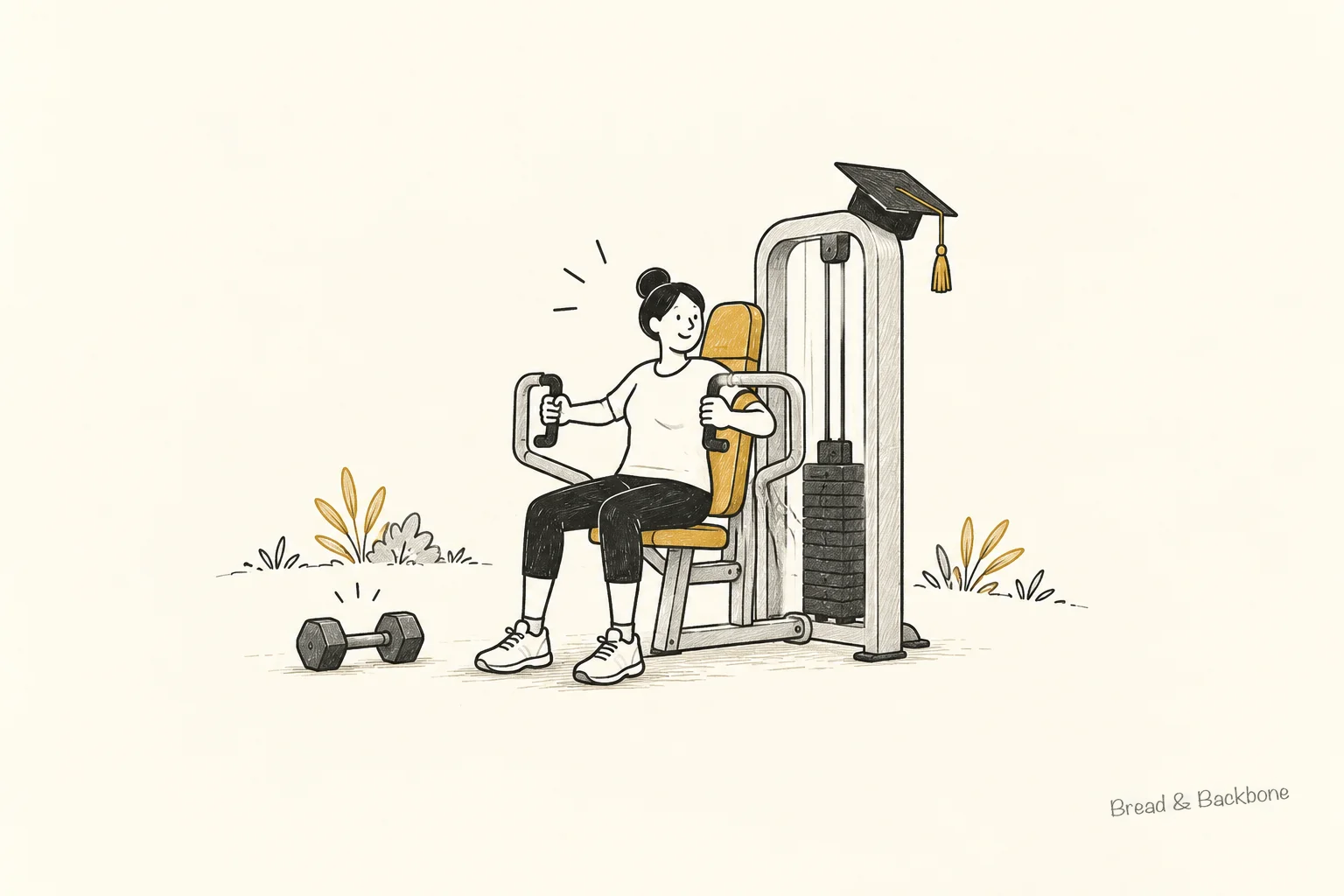
It is an odd graduation ceremony. You were getting stronger, but apparently you were doing it in the waiting room.
You do not have to leave weight machines behind to take strength training seriously. Machines and free weights can both help build muscle and strength. Your choice should reflect your goals, the equipment that fits you and the movements you want to learn. Getting better at a particular lift is a more specific task than deciding whether one side of the gym is superior.
Start with the question the equipment is answering
“Which is better?” leaves a lot unsaid. Better for learning a barbell squat? Better for training during a crowded lunch hour? Better for someone who enjoys a predictable setup and wants to build muscle?
Those are different decisions. A free-weight exercise lets you guide the weight through space. Many machines guide the resistance along a set path. Neither description tells you everything about a particular exercise, and neither is a ranking of the person using it.
If your goal is to improve a specific barbell lift, practicing that lift matters. If your goal is general muscle development, you have more room to choose. That distinction is supported by a 2023 review comparing machines and free weights: it found no detected difference in muscle growth, while strength results depended partly on the type of exercise used to test them.
Only five of the review’s studies measured muscle growth. “No detected difference” is a useful finding, not proof that every machine and free-weight exercise produce identical results in every person.
What the research does, and does not, settle
A separate eight-week study of 38 trained men compared matched programs using machines or free weights. Both groups increased muscle size and strength, with the strongest gains generally in the mode they practiced. This was a small, short study in men who already trained, not a guarantee about every gym member.
The broader direction remains reassuring. In its 2026 guidance, the American College of Sports Medicine (ACSM) reports that equipment type did not consistently change training outcomes for the average healthy adult. It encourages matching a program to the person’s goals and circumstances.
These findings help remove an unnecessary rule: machines are not something everyone must outgrow. They do not establish that all exercises are interchangeable, that one type is always safer, or that either automatically prepares you for every sport and daily task.
It is possible to like free weights, use them well and still choose a machine for another exercise. Your program does not need a team jersey.
Three decisions you can actually make
Try replacing the equipment debate with these questions.
Is there a particular movement I want to learn? If the answer is a barbell squat, ask for help learning that movement. You do not need to justify it with a claim that machines are inadequate. Enjoying a skill is a perfectly sensible reason to learn it.
Does this setup work for me? Consider whether you can adjust the equipment, reach its controls and understand how to start and finish. A machine’s instructions cannot know your proportions or access needs. If you’re unsure about the fit, ask a qualified trainer to check the setup. A guided path does not automatically make it a good fit.
Can I use this choice consistently enough to learn from it? An exercise you can repeat gives you something to observe. Constantly changing equipment because each new suggestion sounds more advanced can make your own notes difficult to interpret.
Curiosity is welcome. So is keeping something that works.
What a mixed program might mean
Consider a fictional gym member who enjoys a machine chest press but wants to learn a dumbbell press. They could learn that new movement while keeping the rest of their familiar routine. There is no need to replace every exercise on the same day.
Another member might have no interest in that change. They want a manageable strength routine, understand their machines and prefer to spend their learning time elsewhere. The equipment evidence does not require them to adopt someone else’s hobby.
A reason for choosing an exercise is more useful than a label attached to its equipment.
If you do switch, let the new movement have its own starting point. Do not assume the number on a machine stack translates into the same free-weight load. Ask for an appropriate introduction, including setup and how to finish the movement safely. A new exercise does not owe you the same number as the old one.
Keep a record that belongs to the exercise
For an exercise already in your program, a short note can make the next visit simpler: the machine or movement, its settings where relevant, the load used and the repetitions completed. Add a question if something about the setup was unclear.
One session cannot tell you whether an entire program is working. Over time, though, these notes give you something more specific to consider than “I think I should be doing something harder.”
If an exercise causes pain, stop and seek appropriate advice.
The next time you consider changing an exercise, finish this sentence: “I want to change this because…”
A skill you want to learn, a setup that needs adjusting or a goal that has changed all give you something useful to discuss. “Someone said I should have graduated by now” deserves a second look.
The weight room has plenty of equipment. It does not need a hierarchy of belonging.
Sources and context
Sources checked October 30, 2026. The gym scenes are original fictional illustrations. This story explains equipment choices, not an individualized training program.