In this story
The pause between sets can feel like time you should be filling. Give it a purpose before you decide it needs to be shorter.
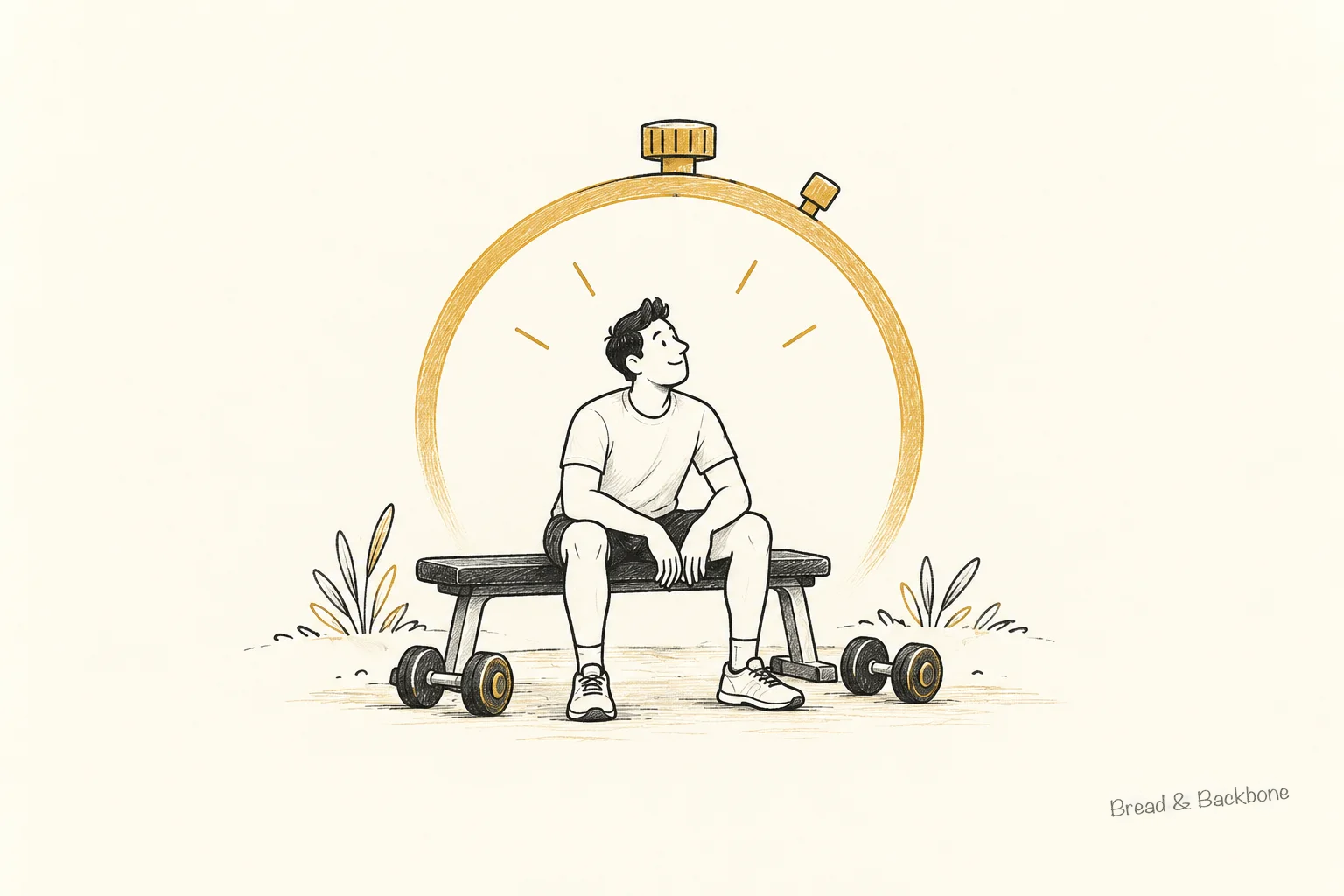
Imagine finishing a set, putting the weight down and checking your timer. Thirty seconds have passed. It feels closer to a small administrative holiday.
You look around. Someone is moving. Someone else is moving faster. You begin to wonder whether standing here is a poor use of a gym membership.
Rest between sets belongs to strength training. It gives you a pause before asking your muscles to work again. The useful question is whether that pause supports the next set, not whether you can make every minute look busy.
There is no single rest interval that wins every workout. Your goal, the exercise and the demands of the session matter. Research gives us a reason not to rush automatically, but it does not give everyone the same countdown.
Look at the set that comes next
A workout plan often makes its visible parts easy to count: exercises, weights, repetitions. The space between them can look optional, so it becomes the first thing you trim.
That space can affect what follows. A 2024 review of rest intervals discusses how very short pauses can reduce the repetitions people complete across repeated sets. The authors found a possible small muscle-growth advantage to resting longer than 60 seconds, but the results were uncertain and varied across studies.
The review included nine studies, with interventions lasting five to ten weeks. Most participants were younger and untrained. It did not establish one best interval for all exercises, ages or experience levels. Nor does its failure to detect a clear additional growth benefit beyond 90 seconds mean that nobody should rest longer.
That last distinction matters. A threshold in a research analysis is not an alarm telling every person in a gym to pick up a weight.
Why one impressive number is not the whole answer
In a small randomized study published in 2016, 21 young, trained men followed programs with either one- or three-minute rests. After eight weeks, the three-minute group had larger improvements in squat and bench-press strength and in one measured area of thigh muscle thickness.
It is useful evidence against the idea that shorter must always be better. It is not a command for everyone to rest exactly three minutes. The study tested a particular program in a particular group, and its muscle-size findings were not identical at every measurement site.
More broadly, updated 2026 guidance from the American College of Sports Medicine (ACSM) emphasizes matching training to the person rather than chasing a single perfect program. For a regular gym member, the practical aim is to understand why a pause is there and how it fits the work being done.
If a trainer has given you a rest interval, ask what it is intended to support. A useful explanation helps you make sense of the plan when the gym is busy, your schedule changes or an exercise feels different than expected.
Use a timer to notice, not to obey
You can start by observing an exercise already in your program. Keep your usual plan and note roughly how long you rest, the repetitions you complete and whether you feel rushed to set up again.
For example, imagine a fictional member whose first set goes as planned, while later sets repeatedly end much earlier than expected. Their notebook shows that they also hurry through the pauses. Rest is now one thing to reconsider, alongside the weight they’re using and how hard the early sets feel. If they’re following a trainer’s plan, they have a concrete question to bring to the next session.
A timer is particularly useful when your sense of elapsed time is unreliable. You might discover that the pause you thought was generous was quite brief, or that a quick phone check has become a separate event. Neither discovery needs a verdict about your character.
You also do not have to turn rest into a second workout. Adding another demanding exercise changes what the pause is doing. Combining exercises can be a deliberate programming choice; it does not have to be the answer to every empty minute.
There are other people in the room
Resting thoughtfully and sharing a gym are compatible activities. If someone is waiting, a simple conversation is often more helpful than abandoning the planned pause or defending it in silence.
You might ask whether taking turns is practical, provided equipment adjustments and the exercises allow it. In another situation, changing stations or using a familiar alternative may make more sense. Follow the gym’s rules and avoid leaving weights or belongings across several stations while you wait.
If the entire session no longer fits, reconsider which parts to prioritize rather than automatically compressing every pause. Fewer planned tasks and a rushed version of all of them are different decisions.
One useful detail for the next session
Choose one familiar exercise and add the rest interval to your notes alongside the work. Notice whether the pause gives you enough time to reset the equipment and approach the next set deliberately. If you are unsure what interval suits the exercise, ask a qualified trainer.
Pain, dizziness or unusual shortness of breath are reasons to stop and seek appropriate help, not reasons to adjust a timer and push on.
Then let the pause be a pause. You can check your notes, take care of the setup and leave the next set until you are ready to begin it.
Your rest timer does not need to make you feel productive. It needs to help the workout make sense.
Sources and context
Sources checked October 30, 2026. The gym scenes are original fictional illustrations. Timing choices should fit the person and program; no universal interval is prescribed here.