
In this story
Serving size, added sugars and Daily Values become more useful when you know which question each number answers.
Imagine turning over a package you were planning to eat for lunch. It says two servings. You see lunch. Before either of you starts an argument, it helps to know what that label actually means.
The serving size on a US Nutrition Facts label describes an amount people typically consume. It does not tell you the right amount for your appetite, your afternoon or your individual nutrition needs. The US Food and Drug Administration (FDA) explains this distinction directly. One package can contain more than one labeled serving, and some labels provide a second column for the whole package.
That leaves a useful job for the label: helping you understand what is in the amount you choose. You can use it without turning every meal into a math assignment. Start with the question you actually need answered.
First, connect the numbers to the food
Before comparing calories, sodium or fiber, check the serving information at the top. Are the numbers for one slice, a cup, half a package or the whole thing? A number without its amount can give a very misleading impression.
Here are a few lines from an invented label for a package containing two one-cup servings.
| Listed item | One cup | Two cups, the whole package |
|---|---|---|
| Sodium | 230 mg | 460 mg |
| Dietary fiber | 3 g | 6 g |
| Total sugars | 8 g | 16 g |
| Includes added sugars | 6 g | 12 g |
Eating two cups doubles these amounts. Eating half a cup gives half of the one-cup amounts. The calculation is the same whether the result is more of a nutrient you want or more of one you are trying to limit. It describes what is there; it does not pass judgment on the meal.
You do not have to calculate everything. Perhaps you are comparing sodium in two soups, or checking whether a snack contains much fiber. Follow the relevant row after checking how much food it describes. FDA’s worked examples show how quantities change with the number of servings.
“Includes” is doing important work
In our example, total sugars are 8 grams per cup, including 6 grams of added sugars. The total is 8, not 14. The added amount is already inside the total.
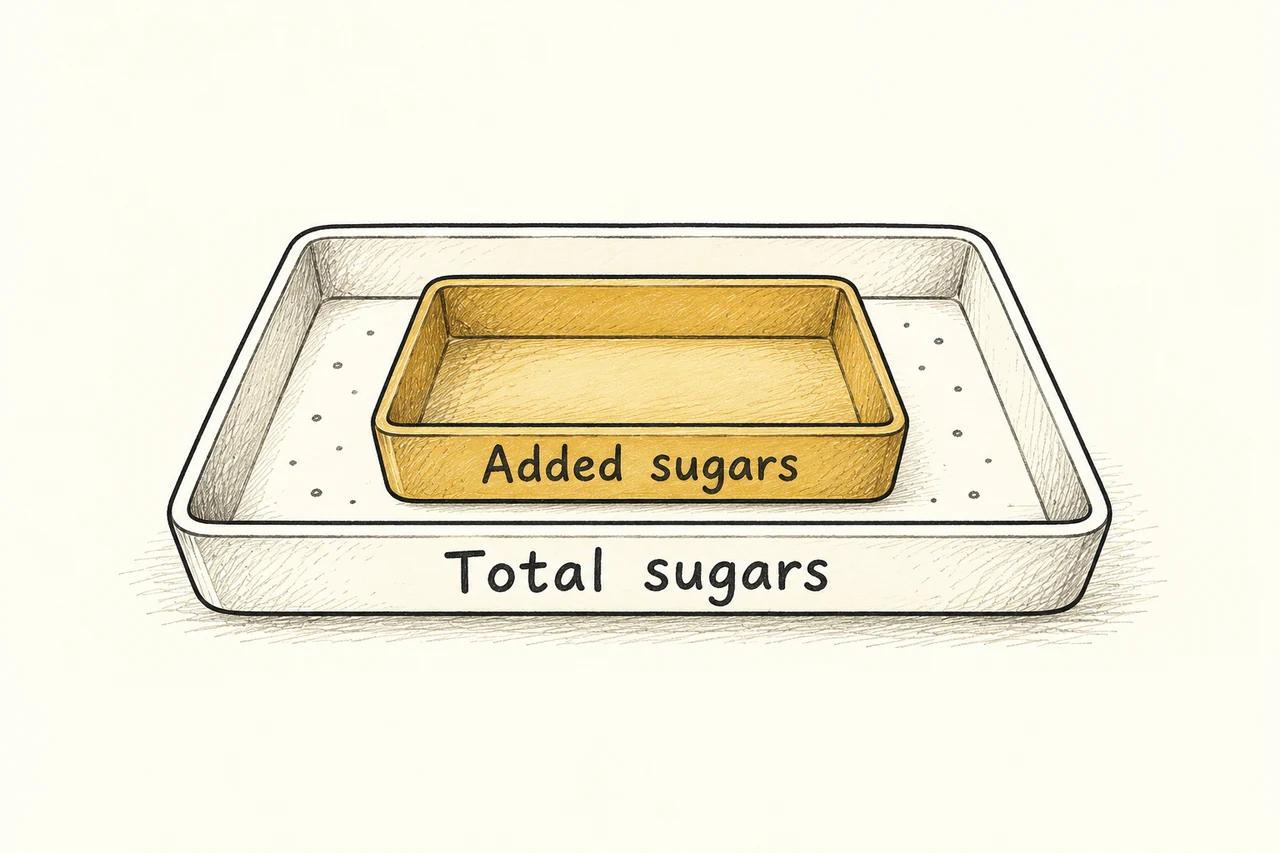
On a typical packaged-food label, the total sugars line includes naturally occurring sugars and any added sugars. FDA’s added-sugars explanation shows why the word “includes” matters. It also explains the different presentation used for single-ingredient sugars and syrups.
That distinction can help you compare similar foods. It does not give you a complete evaluation of a product. Nor does a total-sugar number, by itself, tell you how much sugar was added. Read the two lines together rather than asking one of them to do both jobs.
A Daily Value is a reference point
The percent Daily Value, written as %DV, describes a serving’s contribution to a daily reference amount for a nutrient. FDA uses a general shortcut: 5% DV or less is low, while 20% DV or more is high. These descriptions refer to an individual nutrient per serving. Read FDA’s guide to the percentages.
“High” needs the next word. High in fiber and high in sodium tell you different things. It is not a rating of the food’s character, and “low” is not automatically the goal for every line.
The familiar 2,000-calorie statement at the bottom is a general nutrition reference, not an assessment of your personal requirements. A label has not met you. If you and your clinician or dietitian have agreed on a nutrition target, a printed percentage does not replace that plan.

Some lines have no %DV. Total sugars, for example, has no established Daily Value, although added sugars does. An empty space in that column does not mean the nutrient is absent. The amount in grams is still there.
Give the comparison a fair start
Suppose two hypothetical soups look similar, but one panel describes a cup and the other describes half a cup. Comparing their sodium numbers without adjusting the amounts would compare different quantities of soup. Check the units first, then compare the amount you expect to eat.
Next, decide what matters for this purchase. If your question is about fiber, start there. If you have been advised to watch sodium, that row may deserve your attention. You can consider more than one nutrient without needing a winner in every category.
Price, taste, allergies, convenience and what you will actually use belong in the decision too. The Nutrition Facts panel is one source of information. It cannot tell you whether the food fits your household or whether another package will sit unopened until you discover it behind the mustard.
And a lower number is not a reason to buy something you do not want. The purpose of comparing labels is to make your choice more informed, not to let the smallest number make every choice for you.
Take one useful question shopping
On your next grocery trip, choose a food you buy regularly and look for one thing: the amount described, the fiber content, the sodium, or the added-sugar line. If you compare two options, put their serving sizes on the same footing first.
You may choose a different product. You may buy the usual one with a clearer understanding of it. Either outcome can be useful.
The label’s job is to explain the contents. You still get to decide what lunch looks like.
Sources and context
US label guidance checked October 30, 2026. The sample package and soup comparison are original, hypothetical teaching examples, not product assessments. This story explains label literacy, not an individualized eating plan.