

In this story
The evening you can repeat may look very different from the one you saved on your phone. Here is how to make a little more room for sleep without adding another demanding ritual.
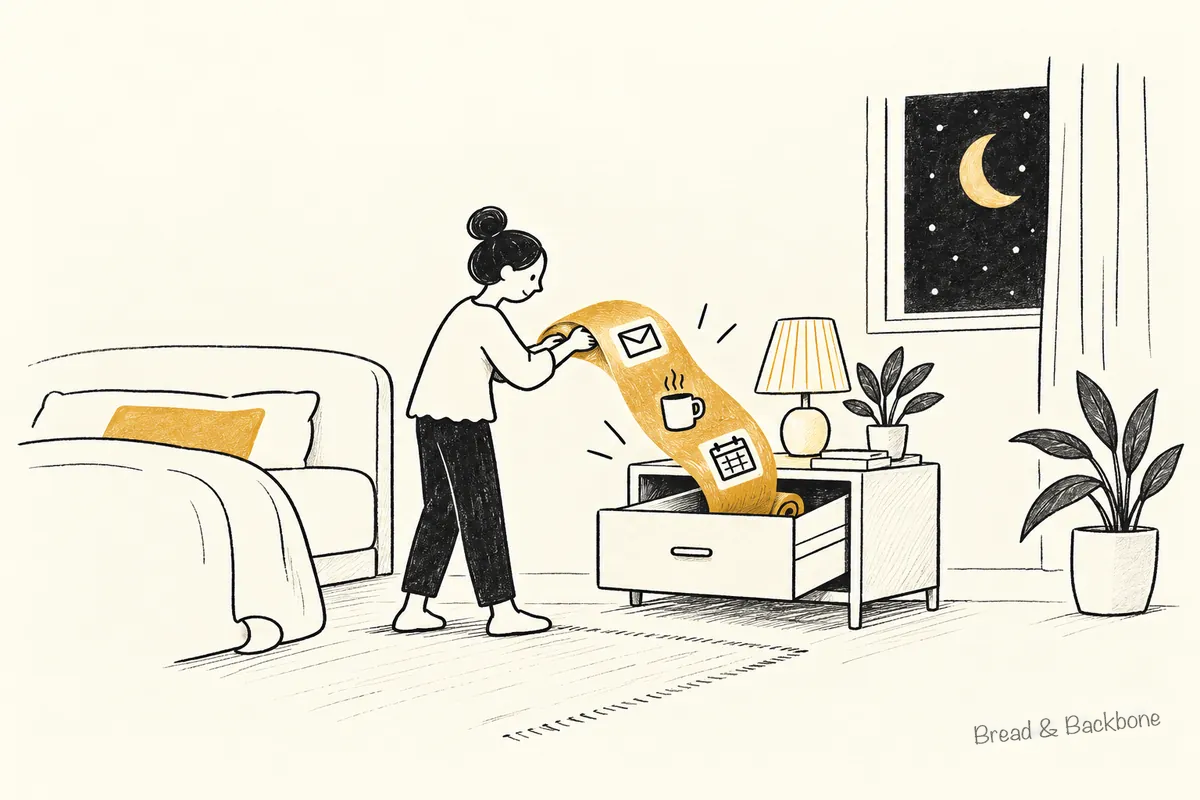
Imagine it is late, the kitchen is still untidy, and you have just remembered the thing you meant to do after dinner. Somewhere on your phone is a beautifully organized bedtime routine. It appears to require an earlier version of tonight.
You could begin its seven steps now. You could also ask whether completing a routine is about to use up the time you wanted to spend sleeping.
A useful sleep routine helps you make room for rest. It does not need to look impressive, and it cannot guarantee that sleep will arrive on command. The starting point is the evening you actually have, including the responsibilities, comforts and interruptions that belong to it.
Make room before adding steps
The National Heart, Lung, and Blood Institute’s sleep guidance starts with allowing enough time for sleep. It also suggests a reasonably consistent schedule, quiet time before bed, and a sleeping space that is dark, quiet and cool.
Those are useful directions, but they are not all equally available to everyone. A person working rotating shifts has a different problem from someone who keeps starting another episode. A parent attending to a child may have very little say over uninterrupted time. A shared room does not become silent because a checklist says it should.
Before choosing a habit, separate what you can change alone from what needs cooperation or resources. Perhaps you can close the laptop earlier. Perhaps you need a conversation about household tasks. Perhaps the apartment noise is beyond your control, and the most useful next step is finding out what practical help is available rather than buying another bedside product.
This does not make sleep less important. It makes the plan more honest.
Choose the transition, not the performance
Some people enjoy a bath, reading or quiet music before bed. Others would rather have less to do. A routine can be a short transition: finish what must be finished, set aside what can wait, and stop adding new tasks to the evening.
It helps to name the actual friction. “I need a perfect wind-down” is difficult to act on. “I start answering work messages after I brush my teeth” is more specific. You might decide when messages stop, while keeping essential contacts reachable. That is a boundary you can consider, not a claim that everyone can put their phone in another room.
The physical setting matters too. NHLBI recommends reducing bright artificial light before bed and keeping the room comfortable for sleep. Caffeine can interfere with sleep, so its place in your day is worth noticing. You do not need to replace all your habits at once or adopt someone else’s precise cutoff as a universal rule. See the general guidance.
If the quietest part of your day is the hour after everyone else is asleep, there may be a real tradeoff here. That time can be valuable. Rather than treating it as a character flaw, ask whether some of what you enjoy about it could happen earlier, or whether a shorter version would still feel like time that belongs to you. The answer might require more than rearranging a lamp.
Give the late evening its own plan
Consider these two fictional versions of an evening. They are planning examples, not a tested sleep treatment or a recommended schedule.
On an ordinary evening: After the essential household jobs, a person puts tomorrow’s bag by the door, switches off work notifications and reads for a while in a comfortable space. They have chosen those actions because they enjoy reading and otherwise tend to return to work.
On a complicated evening: Dinner runs late and a family conversation takes longer than expected. The same person skips the optional reading, leaves a nonurgent chore for tomorrow and keeps only the work-message boundary. They do not stay up to complete every part of the ordinary version.
The difference is intentional. The shorter evening preserves a little space rather than becoming an attempt to catch up with a missed ritual. Neither version tells us whether the person slept well. A plan describes an opportunity; it does not prove an outcome.
Your two versions might have almost nothing in common with these. You may work at night, share a bedroom, or need to remain available to someone. Start with your own nonnegotiable responsibilities. Then identify one optional activity you can shorten or move, and one transition you would genuinely like to keep.
Notice whether the plan helps your life, too
For a few evenings, you could note what you intended to do, what actually happened, and whether you made more room for sleep. A few words are enough. This is a planning reflection, not a scorecard for judging your body or a way to diagnose a sleep disorder.
If the plan keeps failing at the same point, that detail is useful. You might be asking too much of the final part of the day. You might need another person’s help. Or the obstacle may have little to do with your chosen routine.
Sleep also involves more than time on a schedule. CDC notes that quality matters as well as duration. Most adults aged 18 to 60 need at least seven hours a night, with recommendations varying by age. Making time is important, but it does not explain every experience of poor sleep.
When a routine is not the answer
If you regularly struggle to sleep, or sleepiness is affecting daily life, speak with a healthcare professional rather than repeatedly making the routine stricter. General habits are not a substitute for assessing or treating a sleep disorder.
For long-term insomnia, NHLBI describes cognitive behavioral therapy for insomnia, or CBT-I, as a usual first treatment option. That is a structured treatment, not simply a longer list of bedtime tips. Read NHLBI’s treatment overview.
For tonight, you might leave the ideal routine where it is and look at one smaller decision: What can wait, so I can leave a little more room for sleep?
You do not have to finish the whole day before you are allowed to rest.
Sources and context
Guidance checked October 29, 2026. The two evening plans are original fictional illustrations.